Solutions

Advanced Facility Ratings Management for FERC Order 881 Compliance AFRM

Unlock Hidden Grid Capacity and Ensure Seamless Regulatory Compliance


The Federal Energy Regulatory Commission (FERC) Order 881 represents the most comprehensive change to facility rating management in decades. With compliance deadlines rapidly approaching, utilities must transition from static, worst-case weather assumptions to dynamic, hourly Ambient Adjusted Ratings (AARs).

Book a demo
Advanced Facility Ratings Management

What is Advanced Facility Ratings Management?

Advanced Facility Ratings Management (AFRM) is a purpose-built, CIM-based solution designed to automate AAR calculations, integrate real-time weather data, and ensure full compliance with FERC Order 881. Backed by over 20 years of utility software expertise, our platform helps transmission providers optimize grid capacity by up to 40% while maintaining absolute reliability.

What is Advanced Facility Ratings Management
Solutions

Trusted by Utilities Worldwide

As a proud Megger Company, IPS Energy brings decades of specialized engineering expertise to utility data management.

  • Tenaga Nasional Berhad logo
  • Stedin logo
  • Energy Queensland logo
  • AAES logo
  • E.ON logo
  • National Grid Saudi Arabia logo
  • AEP logo
  • Ellevio logo
  • Landsnet logo
  • Lechwerke logo
  • AusNet logo
  • Georgian State Electrosystem logo
  • Saudi Electricity Company logo
  • Svenska kraftnät logo

The FERC Order 881 Challenge

FERC Order 881 mandates that transmission providers implement ambient-adjusted ratings on transmission lines to improve the accuracy and transparency of the Bulk Electric System (BES). Relying on static ratings or seasonal assumptions often leads to underutilization of transmission lines. In fact, research from the U.S. Department of Energy indicates that cold and windy weather can increase a line’s usable transmission capacity by 10% to 40%.

The FERC Order 881 challenge
Solutions

OUR SOLUTION

Advanced Facility Ratings Management (AFRM)

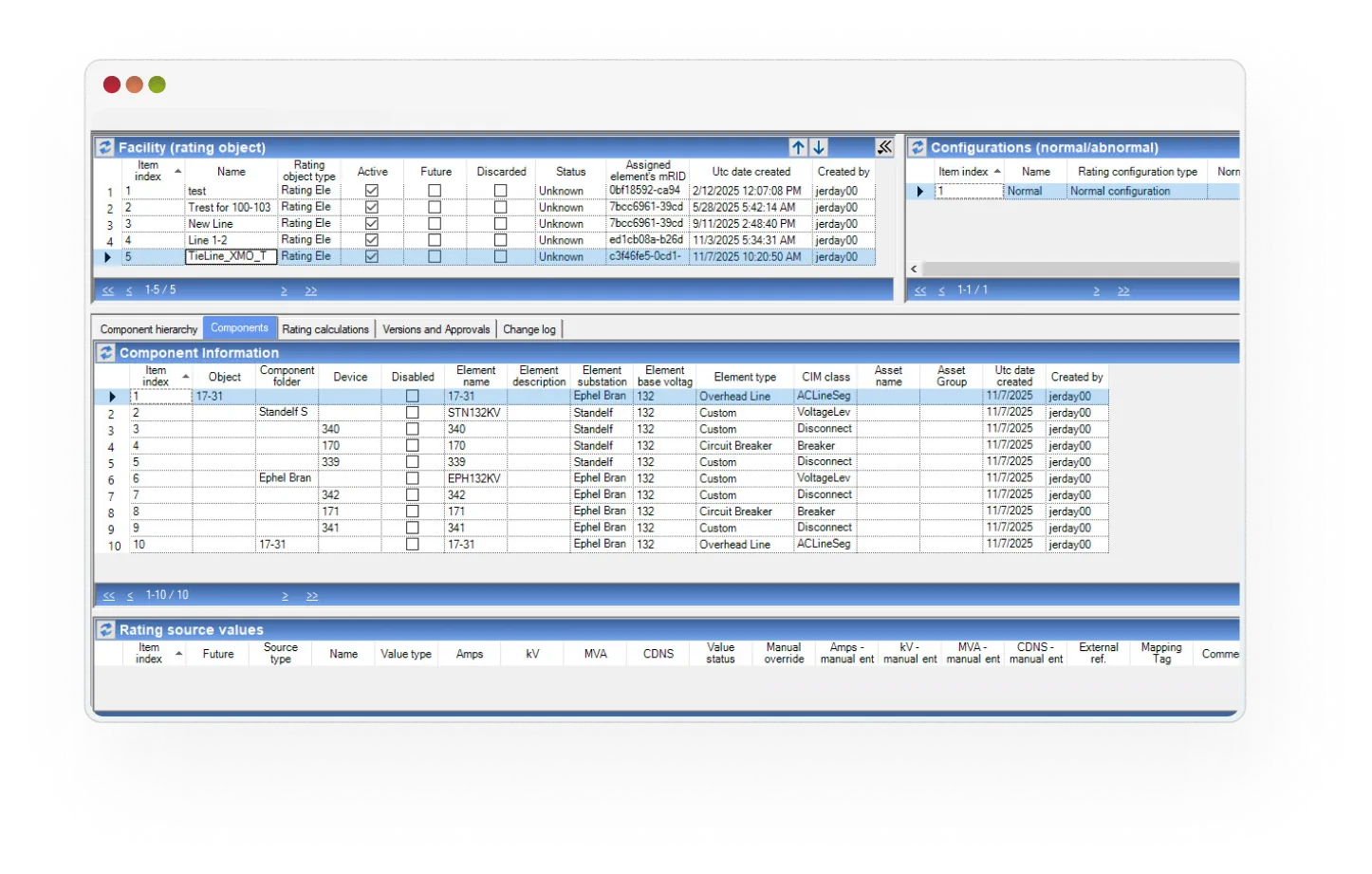
Our AFRM module is engineered to transform regulatory mandates into operational advantages. By utilizing the connectivity defined in your network model, AFRM identifies all electrically connected equipment to ensure accurate, transparent, and compliant facility ratings.

What is grid operations support
Solutions

INSIDE AFRM:

The Features That Power Smarter Facility Ratings Management

Book a Demo to See AFRM in Action

Discover how Advanced Facility Ratings Management (AFRM) can help your utility meet regulatory requirements, optimize grid capacity, and improve reliability. Get in touch to learn more.

Book a demo

Why Choose Us for FERC 881 Compliance?

Staying Ahead of the Compliance Curve

Do not wait until the regulatory deadlines pass. Optimize your transmission grid’s capacity, improve reliability, and experience seamless compliance with FERC Order 881.


Discover how IPS Energy can tailor the Advanced Facility Ratings Management solution to your specific network requirements.

Talk to an expert
Staying ahead of the compliance curve

AFRM Insights & Resources

AI Didn’t Break the Grid. It Exposed It

Discover how AI is transforming electricity demand and how AFRM helps utilities unlock hidden grid ...

Read more
From Static to Dynamic: Unlocking Hidden Grid Capacity

Unlocking additional grid capacity demands a unified, data-driven approach. This document examines the use of ...

Read more
Beyond Borders: Applying FERC 881 Principles to Utilities Worldwide

Couldn’t join us live? You can still access all the key insights, expert perspectives, and ...

Read more
LEARN MORE

Frequently asked questions

Ambient Adjusted Ratings are calculations based on temperature and solar heating, taking into account the difference between night and day. Using ambient air temperature forecasting, ambient adjusted ratings can help balance supply with demand, which is often a significant pain point in extreme temperatures.

Dynamic Line Ratings work by utilizing real-time ambient conditions, including air temperature, wind conditions (direction and speed), solar irradiance intensity (considering both day and night, as well as cloud cover), and other factors. Sensors on transmission lines collect and transmit data on temperature, wind speed, and direction, and can also sense solar radiation, providing large amounts of data at frequent intervals (e.g., hourly or every 15 minutes). This data can be analyzed using advanced algorithms to determine the line’s capacity. These analytics determine the maximum safe current, and the transmission operators can adjust the flow. Dynamic line ratings essentially negate the weaknesses of Static line ratings discussed. DLR calculations, however, can be costly, including the cost of equipment and data management, especially data storage.

AFRM is a specialized software solution developed by IPS Energy to help utilities collect, calculate, and manage facility rating information. It integrates weather data to provide accurate Ambient Adjusted Ratings (AARs) for transmission lines, ensuring compliance with FERC Order 881.

AFRM uses network model connectivity to identify electrically connected equipment and calculates Base, Seasonal, AAR, and Emergency ratings. It integrates real-time and forecasted weather data, automatically recalculating ratings when temperatures change by 5 degrees or more, exactly as mandated by FERC.

Yes. AFRM is a CIM-based solution that can intelligently process data from lines and substations, seamlessly connecting to real-time monitoring systems (such as SCADA/EMS) and business systems for regulatory reporting.

Static ratings rely on conservative, worst-case weather assumptions (e.g., extreme heat and low wind), which often artificially limit transmission capacity. Ambient Adjusted Ratings (AARs) use actual and forecasted ambient air temperatures to dynamically adjust line capacity, allowing more power to flow safely during favorable weather conditions.